People & pay — in the same ledger
Run Indian payroll end-to-end. Fully compliant. Fully posted.
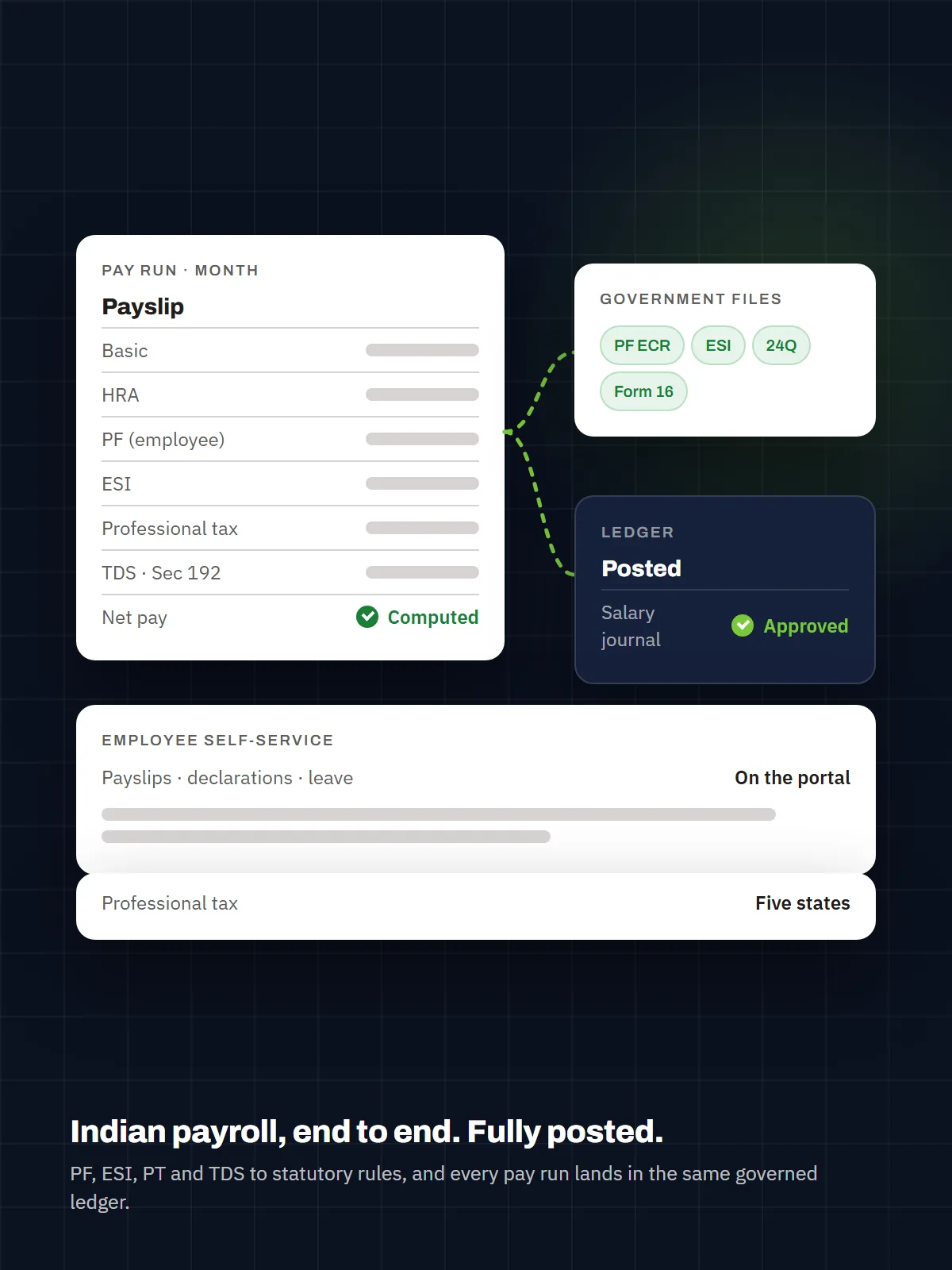
Payroll in Ganav isn’t a separate silo you reconcile later. Every pay run posts straight into the same governed ledger, computes PF, ESI, PT and TDS to statutory rules, and produces the government’s own file formats — while employees get a portal for payslips and leave.
Note: Payroll is an opt-in module, enabled per company.
Everything before payroll — employees, leave, hiring, and more.
- Employees & orgrecords, org chart, lifecycle events, onboarding templates.
- Attendance registera monthly grid that feeds loss-of-pay straight into payroll.
- Leavestatutory types (CL / SL / EL / LOP / maternity) with accrual jobs, carry-forward, and approvals routed through the same workflow inbox as everything else.
- Recruitmentopenings → candidate pipeline → interviews → offers → one-click convert-to-employee.
- Articleship (for professional firms) — ICAI / ICSI / ICMAI milestone tracking.
- HR analyticsheadcount and workforce views.
One governed pay journal per employee, per run.
- Statutory computePF (with the EPS pension ceiling capped correctly, plus EDLI and admin charges), ESI (with correct contribution-period continuation across the ceiling), Professional Tax by state slab, and TDS under Section 192 on projected annual income.
- Old vs new tax regimestandard deduction, HRA and Chapter VI-A, home-loan interest under 24(b), 80CCD(1B), 80E, and 87A marginal relief.
- Full-and-final settlement, arrears, supplementary and bonus runs.
- Frozen historythe employer contribution breakdown is frozen into the pay run, so a later rate change never rewrites what you already posted.
- Governed like everything elsepay runs route through Maker–Checker–Approver; approval and posting are deliberately separate steps.
Indian statutory outputs — in the government's formats
- PFEPFO v2 ECR text file, with EPS/EPF recomputed engine-identically from frozen wages and dated rates.
- ESI / PT / TDSchallans generated as draft payable/bank journals that post through the normal workflow; per-state PT and LWF handled by frequency.
- TDS 192mirrored into a TDS register at pay-run posting; 24Q (all quarters, with Annexure-I and Annexure-II) and Form 16 Part B generated from a frozen year-end snapshot, with a payroll-native FVU builder.
- Professional Taxseeded slabs for Telangana, Andhra Pradesh, Karnataka, Maharashtra, and Tamil Nadu, resolved by employee work-state with company overrides.
- LWFemployee + employer components, posted to GL and remitted per state.
- MSME §43B(h)45-day supplier aging with reminders (shared with the reporting engine).
- Investment declarationsa self-declare → upload proof → verify → lock lifecycle, with a freeze window; the year-end snapshot is lockable and re-computation refuses to run against a locked snapshot.
- Pay-opsNEFT bank-advice file, employee loans/advances with a recovery ledger, a wide payroll register plus a fixed statutory register, and a daily statutory-deadline reminder sweep.
Employee PII, protected
Employee and payslip sensitive fields — PAN, UAN, ESIC number, Aadhaar, bank account — are stored AES-GCM encrypted at rest, with the key held outside the database. Records are masked by default; revealing full details requires a dedicated permission granted only to Company / Payroll admins, and every reveal is audited. PAN and bank details are decrypted only at the exact seam that needs them (a NEFT file, a Form 16), never mirrored into general master tables.
Payslips and leave, in the employee's own login.
A dedicated employee portal where staff download payslips (generated on demand as PDFs — never stored as blobs) and manage leave. Authorization is by identity, not broad permissions, so an employee sees only their own records.