TaskLie Ganav

The engine

A complete double-entry ledger — governed to the core.

Ganav isn’t a light bookkeeping app with reports bolted on. It’s a full multi-company, multi-branch, multi-currency accounting engine where every entry earns its place: reviewed before it posts, immutable after, and reproducible from the journal up.

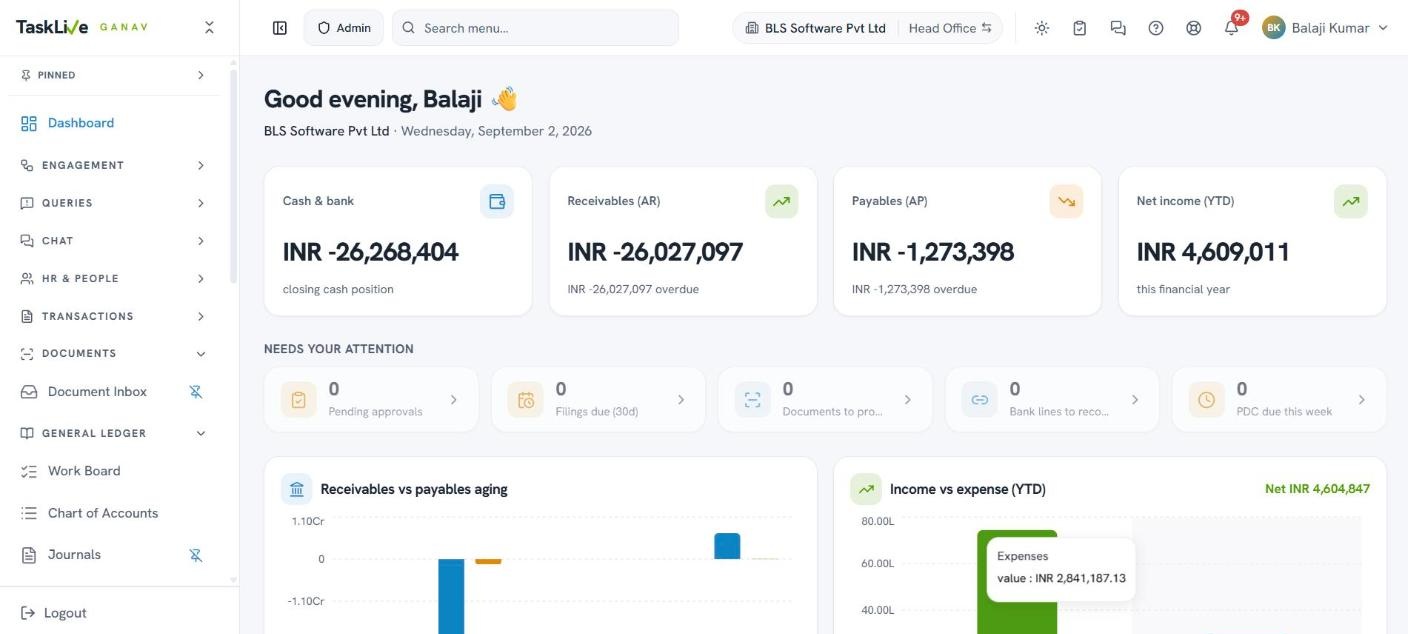
Ganav finance dashboard: cash and bank, receivables, payables and income year to date

Nothing hits your books until it's been reviewed.

Entries flow Draft → Submit → Verify → Approve → Post, and financial impact happens only at posting — inside a single database transaction. Once posted, an entry is locked: you correct it with an audit-safe reversal, never by editing history.

  • Immutable posted entriesheader, lines, voucher number, and period are all locked after posting.
  • Reversal-only correctionsa reversal books the flipped entry referencing the original, and runs the full approval lifecycle. Even after you’ve restructured your chart of accounts, reversals resolve through Ganav’s COA mapping engine and land safely in an open period.
  • Draft clean-up that unwinds itselfdelete a draft voucher and its inbox link and any pending reversal are released with it; nothing is left dangling.
  • Idempotent postinga double-click or a retried job never double-posts or skips a voucher number.
  • Day Bookone chronological register of every voucher, grouped by day, with fiscal-aware period presets (this month, this quarter, this financial year, custom), search, and Excel/PDF export.
  • Recurring journalsset up a template once; generate the repeating entry each period, with history. Foreign-currency templates take the rate on the day they generate, not the day they were written.
  • Opening balancesload prior-system balances at go-live, with Excel import, full-screen grid, reverse/discard, status tracking, and Excel/PDF export for the CA’s sign-off.
  • Voucher types & number seriesconfigure document types with their own rules and gap-controlled numbering carrying a fiscal-year token; a Voucher Number Gaps report proves continuity for auditors.
  • Attachments, full-screenthe source bill, PDF, image, or spreadsheet previews full-screen on every voucher.

Thirteen reports. Two formats. Drill all the way down.

Every report exports to PDF and Excel, filters by dimension (cost center / project), carries fiscal-aware period presets, and — where it matters — a prior-year comparative column and one-click “Publish to client portal.”

The core statements — in the format your CA reads

  • Standard | Tally toggle on Trial Balance, Profit & Loss and Balance Sheet. Standard is the classified statement; Tally is the T-format your CA and your old Tally company produce — the real group tree, two-sided, with Trading and P&L blocks that foot, gross-loss carried across, and the colour-banded column pairs the CA team’s own Excel uses.
  • CA-grouped Profit & Loss and Balance Sheetthe regular statements rendered by group, the way a schedule is drafted.
  • Trial Balance with sub-ledger breakupexpand any control account into its parties and bank accounts, opening and closing side by side; the footings stay honest (control rows only). Three modes: Period, As-of date, and Date range, each with a prior-year column. Drill from any row into the Account Statement — and back, with your window preserved.
  • Cash Flowoperating / investing / financing, with a built-in “reconciles to cash movement” integrity check.
  • Account Ledger and Party Statementthe running-balance ledger for one account or one party; every row drills out to its source voucher.
  • Prior-year-not-closed noticesevery statement tells you when a prior year is still open, so a carry-forward you haven’t run can’t masquerade as a balance you have.

Receivables, payables & tax

  • AR & AP Aging — 7 configurable age buckets; publish as a client statement.
  • MSME Aging (§43B(h)) — track supplier bills against India’s 45/15-day MSME payment law.
  • Tax Summary · Journal Register · Subledger Balances · Voucher Number Gaps · Day Book Capitalization Completeness (asset-account debits with no asset record).

Exports that mirror the screen. Excel exports are styled builders, not dumps: the Tally statements come out as two-sided sheets, the Standard Trial Balance with class bands, sub-ledger nesting, numeric Dr/Cr columns that sum, and a TB Difference line.

Under the hood: live views read live balances; historical/as-of views read immutable period-balance snapshots, never recomputed — so a report you ran last quarter reads the same today. Year-end-closed fiscal years are a hard, immutable reporting boundary.

Every document printed from the ledger, on your letterhead.

Upload the company logo, contact details, a disclaimer and a signatory line once, and every print carries them:

  • Receipt Vouchera customer copy and a separate office copy, with the invoices it settled listed.
  • Payment Voucher and a cheque voucher straight from the post-dated-cheque screen.
  • Tax Invoicecustomer and office copies with the full GST breakup; Credit / Debit Notes.
  • Purchase Bill record (including reverse-charge bills) and Purchase Return (AP debit note).
  • Journal Vouchera single office page, printable at any status for review.

Bank account numbers are masked to the last four digits in the print itself, never in the template.

Every invoice tracked to the paisa — until it's cleared.

  • Document-centric open itemseach invoice, debit note, and credit note becomes one tracked open item. Receipts and payments settle against them; they never create phantom items.
  • Governed settlement engineclearing an invoice is a controlled, system-generated posting, not a hand-typed entry. Partial and full settlement are first-class; the balance auto-updates and the status flips Open/Closed on its own.
  • On-account & advancestake a deposit before an invoice exists, then apply it later.
  • Audit-safe reversalundo a settlement cleanly; the open balance is restored and any FX reversed, while the original stays immutable.
  • Aging that ties outcontrol-account balances always reconcile to the open-item list.

Tax computed as you post — split correctly, frozen once filed.

  • Multi-jurisdiction schemesGST-IN, VAT, and more, with country/jurisdiction and effective dates.
  • Component-level taxCGST / SGST / IGST / VAT, with time-bound rates that are versioned, never overwritten, so historical postings stay reproducible.
  • Inclusive or exclusive pricingenter prices tax-in or tax-out; the engine derives net and tax.
  • Tax-on-postingtax lines generate automatically to the right control accounts and are immutable after posting; they never create open items and are never touched by settlement.
  • Registration-status honestyan unregistered or composition company gets advisory treatment and a warning, not a wrong posting.
  • Immutable return snapshotsfile a return and freeze exactly what was reported; drill from a filed return back to the underlying tax transactions.
  • GSTR-2B reconciliationimport the GSTN GSTR-2B and reconcile it against your purchase register (matched / missing-in-books / missing-in-2B).

Reverse charge, done properly

  • An applicability master seeded with the CA-reviewed categories — import of services, goods transport, legal services, security, sponsorship and the rest — that you can extend.
  • A posting engine that books the RCM liability and the matching input credit in the same voucher, with the markers a return needs.
  • Self-invoice under Section 31(3)(f) generated for RCM purchases.
  • GSTR-3B learns reverse chargethe RCM split lands in the right boxes.
  • ITC eligibility on every purchase lineeligible, blocked under 17(5), or ineligible — visible, not buried.
  • Foreign suppliersrecognised by country; an import of services is proposed as RCM, and a foreign vendor who wrongly charged Indian GST is routed to a correction lane (that GST is never claimed as ITC).
  • Warn, never forceevery RCM proposal is a warning a human accepts; a bill carrying one never auto-posts.

Beyond GST — the rest of India's compliance, in the same platform.

  • TDS suite, end to endeight seeded sections (192, 194A, 194C, 194H, 194I-A/B, 194J, 194Q) with rates and thresholds you control; TDS on vendor bills with the deduction and payable posted in one governed voucher; Section 197 lower-deduction certificates applied automatically; Section 206AA 20% where PAN is missing — as a warning you can overrule, never a silent override; challans; 26Q and 24Q returns with an FVU export; Form 16A and Form 16 certificates; a running TDS register; TDS credit received and a Form 26AS reconciliation for the tax deducted from you.
  • Income Tax module — computation, advance-tax estimation, and a separate tax-books depreciation view for the income-tax written-down-value method.
  • Compliance Calendar — statutory due dates in one place, following your fiscal year even when you regenerate its periods — a natural fit for a CA firm running many clients.

Command centers, not empty screens.

Ganav surfaces what needs attention instead of making you go looking:

  • GL Work Boarddrafts, rejected entries, awaiting-approval, and approved-unposted, with next-step CTAs.
  • Approvals inboxevery item waiting on you, across entity types.
  • Month-End Board (for firms) — every client’s close status in one view.
  • Document Inboxeverything waiting to be coded, with a straight-through rate.
  • Quick-access toolbaryour pinned screens on every page; the sidebar keeps the active group open.
  • Guidance banners everywhereeach screen shows the user’s next action in-place, for every state.

Foreign-currency books, done the way an auditor wants.

  • Paisa-frozen ratesthe exchange rate used is frozen onto the entry at posting; later rate changes never touch posted journals. Rates are stored to 10 decimals and kept as append-only history.
  • Base amounts on every linean FX voucher shows the foreign amount and the INR amount side by side, per line, read from what was actually posted.
  • Realized FX at settlementpay or receive a foreign invoice and the exact gain/loss books itself to dedicated FX accounts. Users never pick the FX account.
  • Unrealized FX revaluation at period-endrevalue open foreign balances at closing rates; the revaluation entries auto-reverse next period, so nothing double-counts.
  • Correct sequencing, enforcedsettlements finalize before revaluation runs, structurally preventing the double-counting of exchange gain/loss.
  • Controlled manual overrideonly where a voucher type allows it, and only with a reason and approval.

Every cheque tracked from receipt to clearance — or bounce.

Cheques hit a PDC control account first, then move to the bank on clearance; on bounce, the impact reverses cleanly. Direction is inferred from the party (a customer cheque is a receivable, a vendor cheque a payable). PDCs clear correctly even across a fiscal-year boundary, cancellation/bounce are governed, and the cheque voucher prints from the same screen.

Acquire, depreciate, dispose — each step posted and approved.

  • Capitalization policyset a threshold and a nudge per company; bills that look like assets are flagged before they post, and a below-threshold item gets low-value advice instead.
  • Bill → asset in one flowcapitalize from the inbox or from a posted bill, net of GST with the ITC choice made explicitly, picking the capital lines from a bundled bill.
  • Schedule II categories seeded (computers, office equipment, furniture, vehicles, plant & machinery, low-value 100% write-off) with HSN-based suggestions and a CWIP ready-to-use guard.
  • Governed acquisitionadding an asset builds and posts its acquisition journal through approval.
  • Depreciation runspreview and post a period’s depreciation as one grouped journal; a daily background sweep auto-posts due periods.
  • Disposalsretire or sell an asset with the gain/loss posted automatically.
  • Capitalization Completeness reportthe audit backstop: asset-account debits with no asset record, with one-click capitalize.
  • A separate income-tax (tax-books) depreciation view.

Match the statement to the books — with AI doing the first pass.

  • Reconciliation workspacestatement vs. book lines, side by side.
  • Import a bank statement — PDF, Excel, or legacy .xls — and track unmatched lines.
  • AI-assisted auto-match within a configurable day-window (3 / 4 / 7 / 14 days); undo any run.
  • Post-from-statementbook a missing entry straight from an unmatched bank line, including in bulk; create the bank ledger on the spot if it’s missing.
  • Finalize / reopen with a lock, and export the reconciliation report.

Know where you're over — favourable vs. unfavourable, at a glance.

Create budgets per account, then see budget-vs-actual variance across 12 periods, with revenue/expense -aware favourable colouring and KPI cards. Budget and compare by dimension, not just by account. Export to PDF and Excel.

Define your own analysis axes — and slice every report by them.

Create custom dimension types and values (cost center, project, region), tag them at the line level, and filter Trial Balance, P&L, Balance Sheet, Cash Flow, and Account Statement by any of them.

Set up like Tally. Close with a checklist. Retain without bloat.

  • Fiscal-year setup that asks like Tally“financial year begins on” and “books beginning from” are separate questions at company creation; editing a fiscal year later cascades to periods and the compliance calendar.
  • Period closea governed run with completable checklist items that generates immutable period-balance snapshots and an FX balance anchor for historical reporting.
  • Year-end closeresets P&L and carries forward only Balance Sheet accounts, with a strictly 1→1 Retained Earnings mapping. Once executed, the year is hard-locked; corrections become traceable next-year adjustment journals.
  • Non-destructive archivalold posted journals move to insert-only cold storage using copy-then-verify-then-mark (never move-only); balances, snapshots, open items, and tax snapshots are never archived — always online.
  • Policy-driven retention & purgeconfigurable by years, jurisdiction, and category; purge only after the statutory window, preserving audit proof.

The ledger your auditor will thank you for.